Steam Machine vs PS5 Pro: After reviewing results from more than 25 games, I find Valve’s compact PC capable but too inconsistent to justify its premium price.
Valve’s Steam Machine aims to bring a large PC game library into the living room without the maintenance normally associated with a desktop computer. Its compact design, quiet operation, and controller focused interface support that ambition. However, the most revealing test is not how far an experienced user can tune the hardware. I judge it by what happens when a buyer connects it to a television, installs a game, and presses play.
A 2 week test across more than 25 titles produced uneven results. Cyberpunk 2077, Hades 2, Overwatch, Elden Ring, and The Last of Us Part II Remastered performed well with limited intervention. Borderlands 4, Control, Ratchet and Clank: Rift Apart, and Warhammer 40K: Darktide required lower settings, visual reconstruction, or further adjustment to deliver stable performance.
Several direct comparisons also showed the PS5 Pro producing cleaner images in motion. These results do not form a controlled laboratory benchmark. They are more useful as a measure of whether the Steam Machine provides the simple and predictable experience that its console shaped design implies.
The 1080p Upscaling Path Needs Clearer Definition
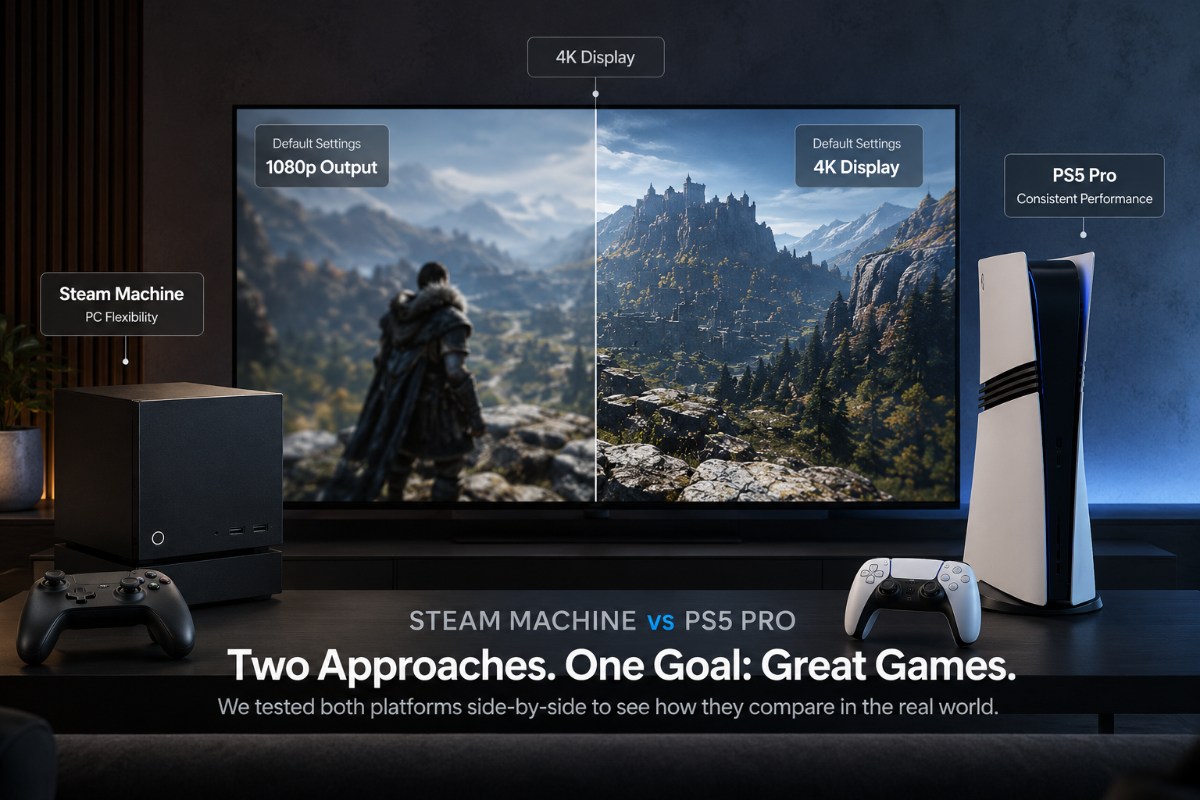
Most games were left at a 1080p output while the Steam Machine was connected to a 4K television. That does not necessarily mean SteamOS reconstructed every image to 4K.
While retracing the test configuration and checking how each game handled its display output, I could not confirm whether SteamOS, the graphics driver, or the television performed the final scaling of the 1080p signal. The games were generally left at the resolution selected by the system or their initial configuration. In those cases, the process was ordinary display scaling rather than confirmed image reconstruction.
The distinction becomes clearer when a game uses FSR through its own graphics menu. FSR renders the scene at a lower internal resolution, then reconstructs a higher resolution image before sending it to the display. That work happens through the game and its graphics pipeline, not through a universal SteamOS setting.
Basic display scaling can enlarge a 1080p picture to fill a 4K screen. It cannot restore fine detail with the same precision as a properly configured reconstruction system.
Default Profiles Matter More Than Maximum Performance
I found the Steam Machine’s strongest results encouraging. Cyberpunk 2077 approached 60 frames per second with some ray tracing, while Overwatch remained responsive after its visual settings and resolution were increased. Older games and less demanding independent releases also suited the hardware well.
The weaker cases exposed a software consistency problem. Borderlands 4 needed changes to its graphics and FSR configuration. Darktide required medium settings and FSR to move from frame rates in the middle 40s toward 60. Ratchet and Clank needed substantial reconstruction and disabled ray tracing before its performance became reasonably stable.
One user argued that the purpose of a Steam Machine is to avoid changing the settings of every individual game. That reaction identifies the standard Valve must meet. A device presented as a living room alternative should not require buyers to understand internal resolution, frame generation, reconstruction modes, and graphics presets before every session.
Kotaku reviewer Zack Zwiezen called the Steam Machine “a really cool piece of gaming hardware,” but judged it too expensive to recommend beyond dedicated tinkerers, a conclusion that reflects the setup burden exposed throughout the testing.
PS5 Pro Holds The Consistency Advantage
The PS5 Pro does not gain its advantage through hardware power alone. Fixed specifications allow developers to create tested graphics modes for one known platform. Buyers therefore face fewer variables between installation and play.
Steam Machine offers freedoms that Sony’s console cannot match. Users gain access to existing Steam libraries, game modifications, older PC releases, and detailed visual controls. I see genuine value in those features for people already comfortable with PC gaming.
Yet price and convenience remain central to the final judgment. Valve has built a capable and flexible compact PC, but it has not removed enough adjustment and compatibility work to make the system a stronger straightforward purchase than the PS5 Pro.
Also Read: PlayStation Without Discs: Why Sony’s Digital Shift Has Players Eyeing PC

Anup Singh is an independent technology journalist and content writer covering Apple, Android, AI, laptops, gaming, and the consumer tech industry. He focuses on delivering factual, well researched, and easy to understand reporting while explaining how new technologies impact everyday users.
1 thought on “Steam Machine’s Default Settings Expose Its Gap With PS5 Pro”