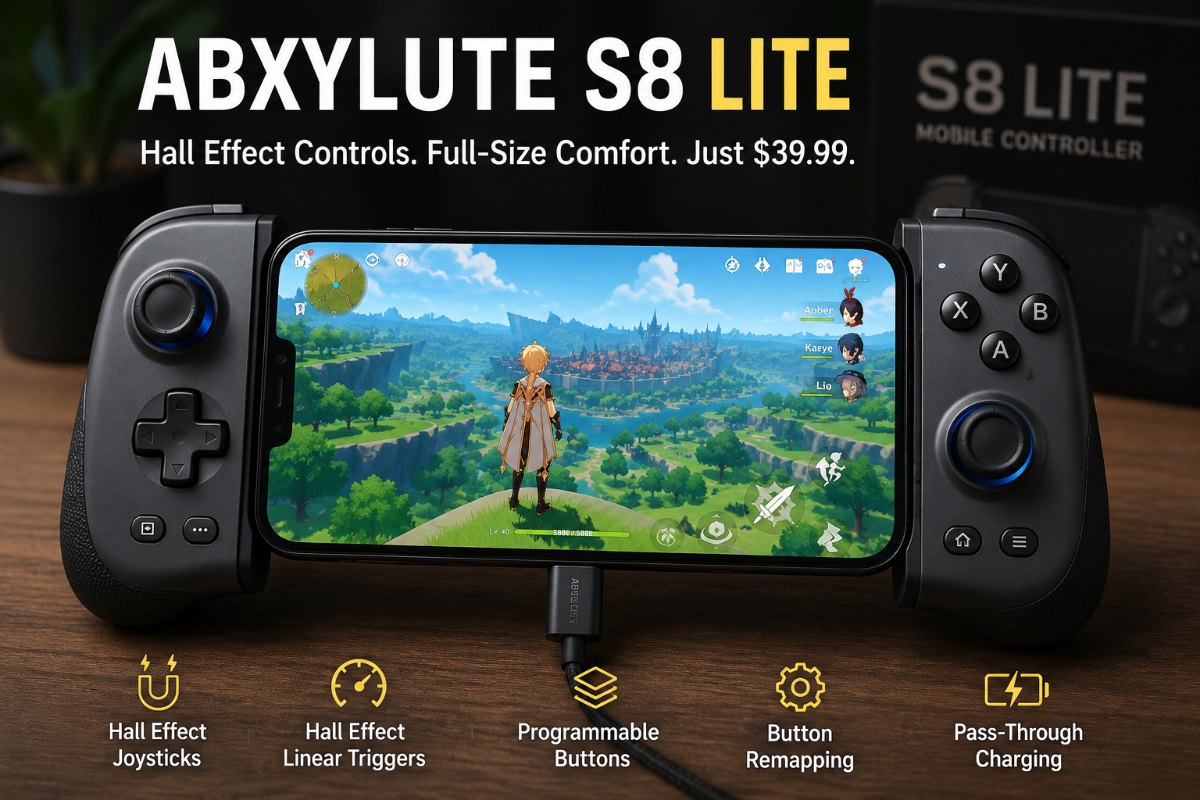
Abxylute cuts wireless support to bring drift resistant controls and full size mobile gaming grips to a much lower price.
For mobile gamers searching for the best budget mobile controller, Abxylute’s new S8 Lite makes a clear pitch: Hall Effect hardware without the usual premium accessory price. At $39.99, down from its regular $49.99 price, the current offer looks more like a launch discount than a confirmed permanent cut. That price is the hook. The S8 Lite is not trying to be the most versatile controller in the category. It is trying to give phone and tablet players the core control upgrades they usually expect from more expensive mobile accessories.
The tradeoff is clear. The S8 Lite loses the Bluetooth support found on the original S8. That means it cannot physically connect to Nintendo Switch hardware, including Switch 2, because its central USB C plug is built for phones and tablets, not console rails or wireless pairing.
Hall Effect Controls Are The Real Story
Hall Effect joysticks use magnets to detect movement. Because they do not rely on the same grinding mechanical contact as traditional sticks, they are designed to resist the wear that causes stick drift. That matters in a budget controller, where durability often becomes the first compromise.
The S8 Lite features Hall Effect technology in both its joysticks and linear triggers. The triggers matter too. They allow smoother, friction free input for games where pressure control matters, such as racing titles, shooters, and action games with variable acceleration or aiming.
This is the main reason the S8 Lite is more interesting than another cheap phone grip. While it does not invent Hall Effect hardware for mobile controllers, its $40 price makes the feature much easier to reach.
The Wired Design Keeps Costs Down
Abxylute described the S8 Lite as offering “full size comfort, instant USB C plug and play, and Hall Effect precision.”
That pitch is sensible, but it also sets a high bar for the hardware. A wired controller has fewer excuses. It should connect quickly, hold the phone securely, and keep buttons consistent over long sessions.
Your phone dictates compatibility. The S8 Lite supports USB C Android phones, USB C iPhones, and tablets up to 216 mm, or about 8.5 inches. In practical terms, that means it should handle large phones such as an iPhone 15 Pro Max and compact tablets such as an iPad Mini.
Key fit details:
Phone length: 110 to 185 mm, about 4.3 to 7.3 inches, without a case.
Maximum tablet span: 216 mm, about 8.5 inches.
Device depth: 13 mm or less, about 0.5 inches.
Camera depth: up to 5 mm, about 0.2 inches.
That makes case size important. Slim cases may fit depending on the phone, but bulky protective cases should be treated as likely removal items before buying.
The controller also includes programmable back buttons, a swappable D pad, adjustable joystick sensitivity, button remapping through Abxylute’s app, and passthrough charging. The remapping software matters because it lets users tune the controller around specific games instead of relying on one fixed layout. That is useful, but only if the app stays simple, stable, and quick to use.
A $40 Controller Now Challenges Pricier Rivals
The S8 Lite puts real pressure on mobile controllers that sit near the $100 mark, including the Backbone One and Razer Kishi V2. Those devices still have brand recognition, polished apps, and strong retail presence. Abxylute is attacking from the other direction: lower price, useful hardware, fewer wireless ambitions.
That strategy can work, but only if the build quality holds up. Budget controllers often lose trust through loose fits, cheap buttons, weak apps, or awkward ergonomics. A spec sheet does not solve those problems.
Still, the value argument is hard to ignore. Premium features like Hall Effect controls, programmable buttons, and passthrough charging now sit near $40. That forces pricier competitors to explain exactly what their premium buys.
Also Read: Soaring Memory Costs Force PC Makers And Data Centers To Resurrect DDR4

Anup Singh is an independent technology journalist and content writer covering Apple, Android, AI, laptops, gaming, and the consumer tech industry. He focuses on delivering factual, well researched, and easy to understand reporting while explaining how new technologies impact everyday users.
1 thought on “The $40 Abxylute S8 Lite Delivers Hall Effect Joysticks to Gamers on a Budget”