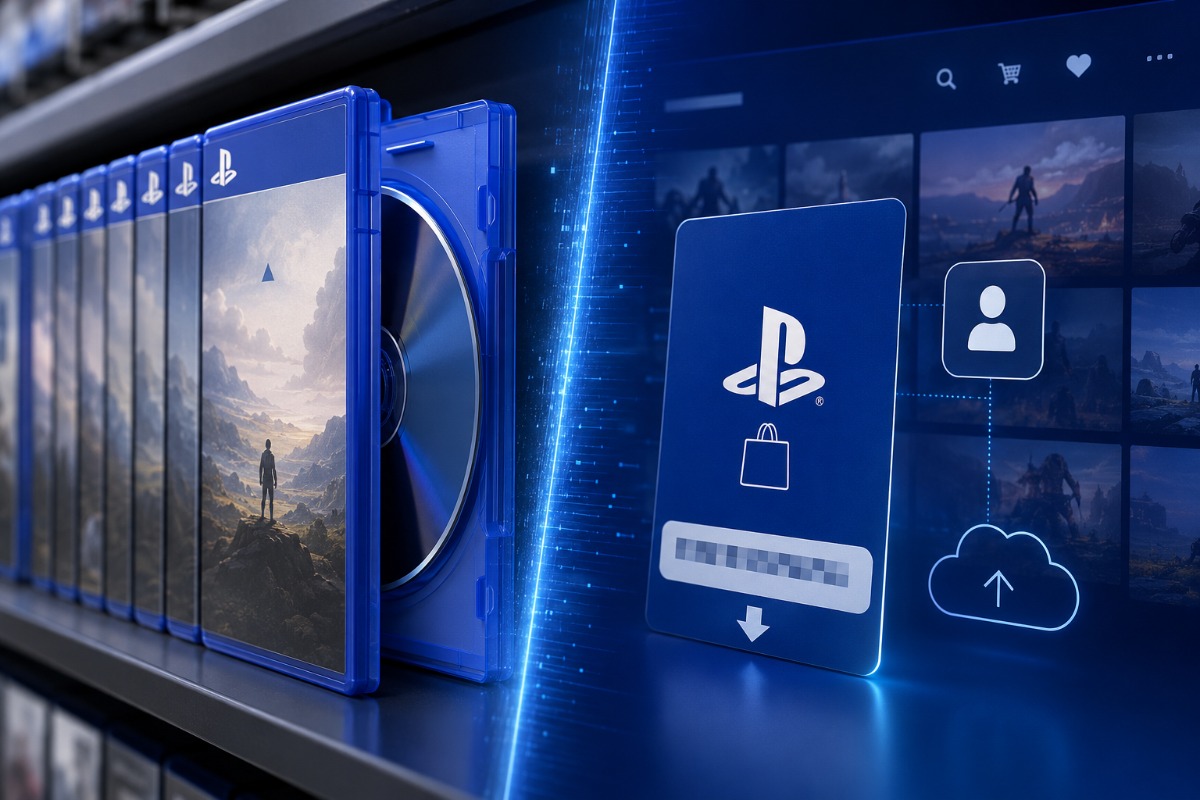
Sony Disc Reprint: A quiet publisher update protects older PlayStation discs, but Sony’s January 2028 digital deadline still stands for every new release.
Days after Sony announced that new PlayStation games would stop shipping on physical discs from January 2028, the company has left publishers 1 major escape hatch for older titles. Game File first reported the clarification from Sony’s private PlayStation developer portal, which told partners that games released on disc before the deadline can still receive new physical reprints after the change takes effect. That allows publishers to keep older games in circulation and gives collectors some confidence that existing physical libraries will not vanish overnight. The future, though, remains locked in place. New PlayStation games released after the January 2028 limit will move into digital distribution, even when retailers still sell boxes on store shelves.
The Rule Is Still Clear
Sony’s July 1 announcement set the baseline. From January 2028, physical disc production for new PlayStation games will stop. New releases will still be available through the PlayStation Store and through retailers, but the retail product is expected to change. Instead of a stamped disc, buyers may get a box with a download code inside.
That retail model is no longer hypothetical. GTA VI has already become the clearest example, with its planned boxed version expected to use a digital redemption code rather than a traditional game disc. For Sony, that is the shape of the shelf after 2028: the store display remains, but the physical copy disappears.
The new guidance softens Sony’s policy only for existing catalogs. A PS5 game released in late 2027 with a disc version is not doomed to a final print run. Publishers can still order new disc copies later, potentially well into the 2030s. Sony has also told publishers that the disc ordering process will change, although the revised system has not yet been disclosed. The exception is broad for games that make the January 2028 line. It offers nothing to games that arrive after it.
Why Players Still See A Loss Of Control
The backlash is not just about plastic cases or shelf displays. It is about ownership. A disc gives players practical rights that a download code cannot match. It can be lent, resold, collected, installed later and preserved without depending entirely on a platform account.
That is why the reaction to Sony’s clarification remains tense. The reprint exception answers 1 fear about older games, but it does not answer the larger concern that new releases will become account bound purchases with less flexibility. In the Threads discussion around the news, commenter donmccoy94 put that frustration bluntly.
“That is not really better. We want physical games, why is that hard to understand?”
A hollow box on a shelf might look familiar, but it removes much of what made physical games useful. Once a code is redeemed, the game becomes tied to an account. Players lose the ability to trade it in, pass it to a friend or keep it as a truly independent copy.
Sony Is Following The Industry’s Money
The ownership argument runs straight into the business logic of modern gaming. Sony says the shift reflects consumer habits, and Reuters reported that digital downloads made up about 80% of Sony’s full game software sales in fiscal 2025. Digital sales reduce manufacturing costs, simplify distribution and keep more control inside the platform storefront.
Players have reasons to distrust that trade. Digital access can become fragile when licensing deals expire, servers close or platform rules change. Sony users have already faced the planned loss of access to more than 500 purchased StudioCanal titles because of licensing agreements, a case that sharpened fears around digital libraries.
A Real Exception, Not A Reversal
Sony’s disc reprint guidance gives publishers breathing room. It also buys time for collectors, preservationists, local game shops and players who still rely on used physical copies to keep gaming affordable.
But this is not a retreat from the digital plan. It is a controlled exception for the old catalog. Sony is keeping the past available on discs while moving future releases toward codes, accounts and storefront control.
That is why the clarification lands awkwardly. It solves a real problem for older PlayStation games, but it does not answer the larger anxiety. Players are not only asking whether old discs can be reprinted. They are asking whether the next generation of PlayStation games will give them anything permanent to own.
Also Read: Qualcomm’s Entry-Level Snapdragon X2 Elite Tests The Waters For Next-Gen Windows PCs

Anup Singh is an independent technology journalist and content writer covering Apple, Android, AI, laptops, gaming, and the consumer tech industry. He focuses on delivering factual, well researched, and easy to understand reporting while explaining how new technologies impact everyday users.
1 thought on “Sony’s Disc Reprint Loophole Gives PlayStation Collectors A Temporary Lifeline”