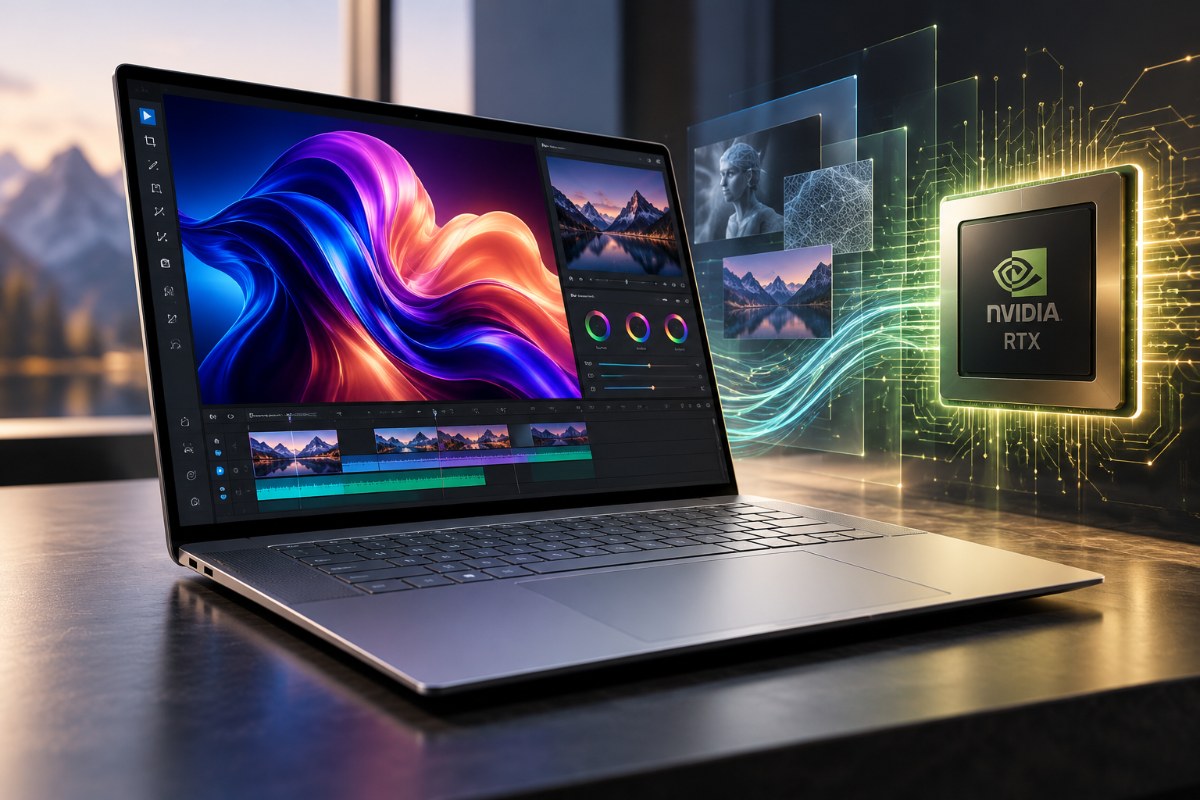
XPS 16 Dell’s first RTX Spark-powered XPS brings up to 128GB of unified memory and native CUDA support. However, its $3,800 starting price includes just 512GB of storage.
Dell’s XPS 16 Creator Edition is expanding globally, bringing NVIDIA’s RTX Spark platform to customers in Canada, the UK, Europe, and Australia. The 16-inch laptop is the first XPS powered by NVIDIA’s Arm-based Grace CPU and Blackwell RTX GPU on a single chip, with up to 128GB of unified memory shared between them.
The design puts Dell in direct competition with Apple’s 16-inch M5 Max MacBook Pro, particularly for developers who want to run demanding AI models locally without renting cloud GPUs.
The entry model costs $3,799.99 in the US, CAD 5,299.99 in Canada, £3,845.45 in the UK, €4,419.03 in Germany, and AUD 6,030.35 in Australia. The UK, German, and Australian prices include local VAT or GST. Each configuration comes with an 18-core CPU, a 5,120-core GPU, 32GB of memory, and a 512GB SSD.
Dell is accepting direct orders in these markets, although regional delivery dates depend on the selected configuration and destination.
NVIDIA RTX Spark Brings Unified Memory and CUDA to Windows
Most conventional Windows laptops give their GPUs a separate pool of video memory, typically 16GB to 24GB on high-end gaming models. RTX Spark instead allows its CPU and GPU to share a large, high-bandwidth memory pool.
With 128GB available, developers can load quantized 70-billion-parameter language models that would exceed the dedicated VRAM limits of conventional laptops. Actual inference speeds will depend on memory bandwidth and whether Dell’s 17.8mm chassis can sustain performance under heavy workloads.
NVIDIA’s main advantage over Apple’s M5 Max platform is native CUDA support. Apple relies on Metal and MLX for GPU acceleration, while NVIDIA and Microsoft have introduced PyTorch with CUDA support for Windows on Arm.
Dell lists Blender, DaVinci Resolve, Photoshop, and Premiere as native applications. Software such as MATLAB can run through Windows 11’s Prism emulator, although incompatible drivers still require native Arm64 support.
Dell’s $3,800 Entry Model Comes With Just 512GB Storage
Dell’s $3,999.99 configuration upgrades to a 20-core RTX Spark CPU, increases the GPU from 5,120 to 6,144 cores, and doubles storage to 1TB while retaining 32GB of memory. A 64GB memory version costs $4,799.99, while the top US configuration reaches $6,999.99 with 128GB of memory and 2TB storage.
That makes the 512GB base SSD particularly difficult to justify for a machine intended to handle large AI models and professional video projects. The limited storage has also drawn criticism in the r/laptops community, where commenters questioned Dell’s pricing against competing machines.
“The storage situation on premium laptops is becoming a joke, 512gb at nearly 4 grand is just insulting,” wrote one commenter.
ASUS undercuts Dell by $600, selling its ProArt P16 with the same 20-core RTX Spark chip, 32GB of memory, and 1TB storage for $3,399.99.
Apple offers another direct comparison. Its 16-inch M5 Max MacBook Pro starts at $3,899, while a configuration with a 40-core GPU, 128GB of unified memory, and 2TB storage carries a $6,999 list price. That places it almost exactly alongside Dell’s highest-priced XPS 16 configuration, although both machines use different GPU architectures and software acceleration platforms.
Display, Connectivity, and Performance Still Need Testing
Dell’s 3.2K tandem OLED panel reaches 1,000 nits of peak HDR brightness and supports a 120Hz refresh rate. Tandem OLED technology uses two light-emitting layers to improve brightness and panel longevity.
ASUS offers a higher-resolution 4K OLED panel rated for 1,600 nits of peak HDR brightness. However, independent testing will be needed to compare sustained brightness, color accuracy, and display quality.
Dell includes a 99Wh battery, three USB4 Type-C ports, HDMI 2.1b, a full-size SDXC card reader, and a 3.5mm audio jack. ASUS offers similar connectivity while adding a USB-A port and a slightly larger 99.9Wh battery.
Dell has not announced a dedicated Linux version of the XPS 16 Creator Edition. As international orders begin reaching customers, independent testing will need to establish sustained AI inference performance, thermal behavior, and battery life.
Those results will determine whether Dell’s $600 premium over the similarly configured ASUS ProArt P16 translates into any measurable advantage for professional creators and AI developers.
Also Read: Mixing NVIDIA DLSS With AMD Frame Generation Beats Native DLSS in Four PC Games

Anup Singh is an independent technology journalist and content writer covering Apple, Android, AI, laptops, gaming, and the consumer tech industry. He focuses on delivering factual, well researched, and easy to understand reporting while explaining how new technologies impact everyday users.